
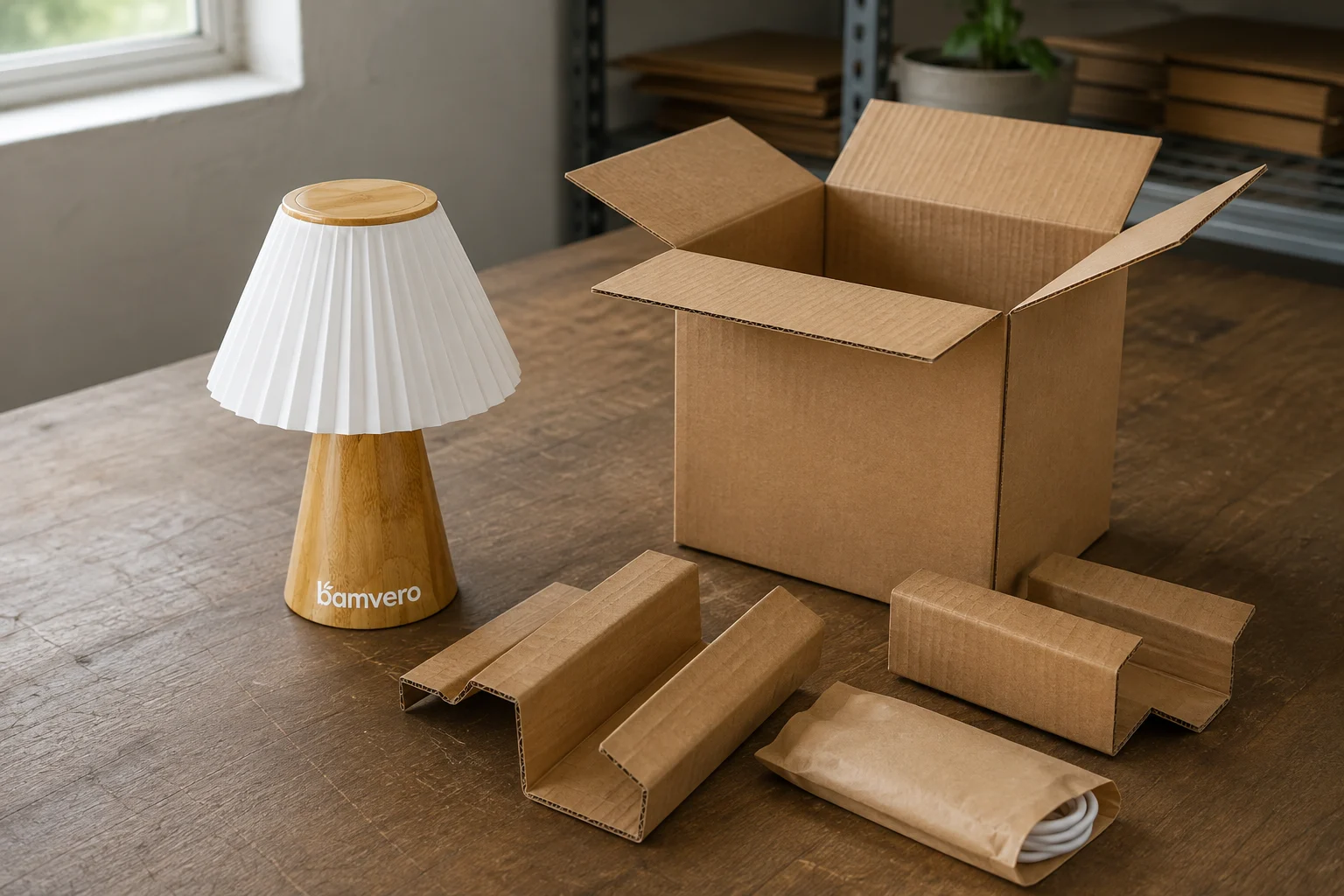
AI-generated packaging-planning illustration, not an approved pack or transport-test record. The actual supports, accessories and carton must be agreed with the supplier.
Packing Pleated Table Lamps for E-Commerce Orders
Start with the delivery route, protect the delicate shade and approve a complete packing method before treating a table lamp as ready for parcel fulfillment.
A lamp can look perfect when it leaves the packing table and still arrive with a visibly distorted shade. For an online order, the customer sees the unboxed product before any of the care that went into choosing it. Packaging therefore belongs in the buying decision, not at the end of the artwork process.
The T2631 bamboo pleated table lamp is a useful starting point. Its product listing identifies a natural bamboo base, white pleated shade, warm ambient light and USB-C power interface. These are different surfaces and components to protect. A box that holds the base firmly is not automatically protecting the shade.
Map the journey before choosing the box
Describe how the order will reach the buyer. A master carton sent to a retailer, a single lamp dispatched from a warehouse and a gift set shipped directly to a recipient are different packing briefs. Identify where the product is unpacked, relabeled or placed in an additional outer carton, and which party controls each stage.
Give the supplier the intended sales channel and fulfillment arrangement. Ask whether the proposed pack is a retail presentation box, a transport pack or a combination that still needs an outer shipper. An attractive printed box should not be treated as parcel-ready without an agreed assessment of the finished pack.
Protect the shade without squeezing it

Start with an intact sample and identify where packing material can safely support it. The pleated edge should not become the part that carries pressure when the box is closed. Review the proposed supports with the supplier, paying attention to the space above the shade, lateral movement and contact between the base and surrounding materials.
Do not assume the shade can be removed, flattened or nested for shipping. Those options must be confirmed for the supplied construction. If the lamp is intended to ship assembled, evaluate that arrangement rather than inventing a smaller package that requires the customer to carry out an unsupported assembly step.
Give the cable its own place
A loose connector can move against a visible finish during handling. Put the confirmed cable and other included accessories in a defined compartment or secured pocket, then check that they cannot press into the shade or controls. The packaging instruction should show the accessory position, not just say “add cable.”
USB-C identifies the interface; it does not establish that a mains adapter, battery or particular charging capability is included. Match the contents list to the quotation and sample. If a power accessory is optional, keep that choice clear in both the online listing and the packing specification.
Measure the pack you will actually send
Record the outside dimensions and weight of the finished shipment after the lamp, supports, accessories and inserts have been packed. Do not use the product dimensions as shipping-box dimensions. For a quote comparison, ask each supplier to identify whether the figures describe the individual retail box, the outer parcel or the master carton.
Bring those measurements into a carrier or fulfillment quotation for the intended route. A larger protective arrangement may change shipping costs, but making the box smaller is only useful if the product remains properly protected. The master-carton planning guide explains the broader separation between unit packaging and shipment totals; a pleated shade still needs its own product-specific review.
Open the trial pack as a customer would
Document the pack before the trial: model revision, box and support materials, accessory position and assembly sequence. Agree the transport-test method and acceptance criteria with the buyer or testing provider for the intended distribution route. An informal shake or a single sample shipment can reveal a problem, but cannot establish a universal shipping-performance claim.
After the agreed trial, inspect the box and then the lamp. Record creases, rubbing, displaced components, loose items and any change in normal operation. Photograph the same areas before and after, and change the specific support or packing step associated with the finding. Retain the revised pack as the reference rather than approving a new box from a flat drawing alone.
Write a packing instruction that survives a reorder
A repeatable record names the lamp version, box size, support layout, included accessories and sequence of packing. Include an image of the completed open pack and one of the sealed shipment with its agreed marks. This gives a new packing operator something more useful than an attractive lifestyle image.
For a focused lamp shortlist, specify the sales channel as well as the lighting style. When requesting a Woodshowtime quotation, include T2631, order quantity, destination, individual-parcel or wholesale delivery, branding, accessories and the proposed packaging trial. Discussing those details early makes packaging part of the offer instead of a surprise after the lamp has been selected.
Match the product to the way it will be used.
Align the target channel, product functions, destination market, branding and packaging route before approving a sample or bulk quotation.