Bamboo Electronics Wholesale: How to Plan a Mixed-Model Order
Build a mixed-model order around distinct customer jobs, comparable quotations, category-specific sample checks and measurable reorder rules.
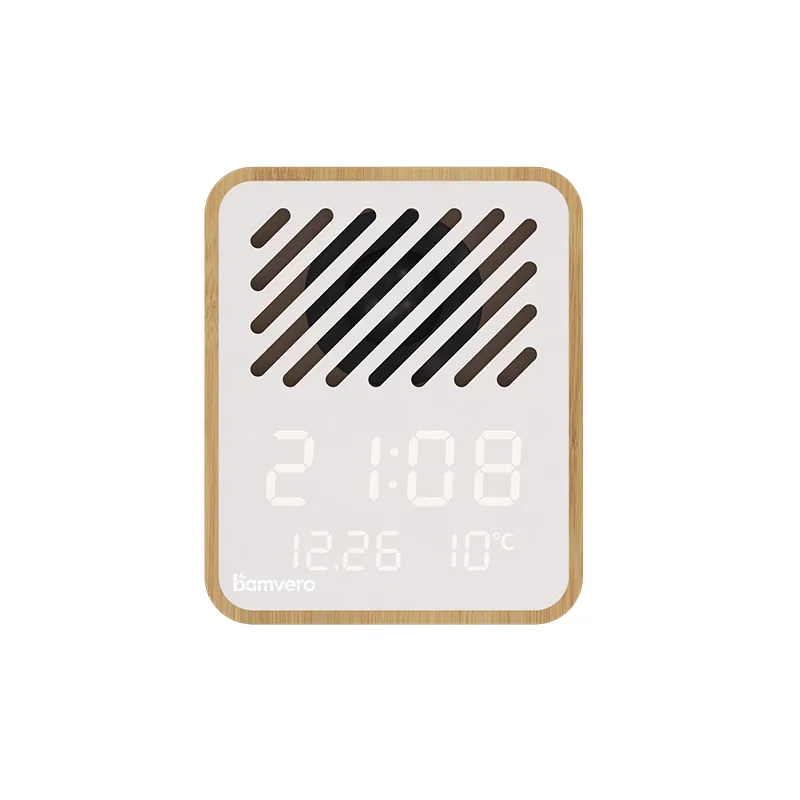
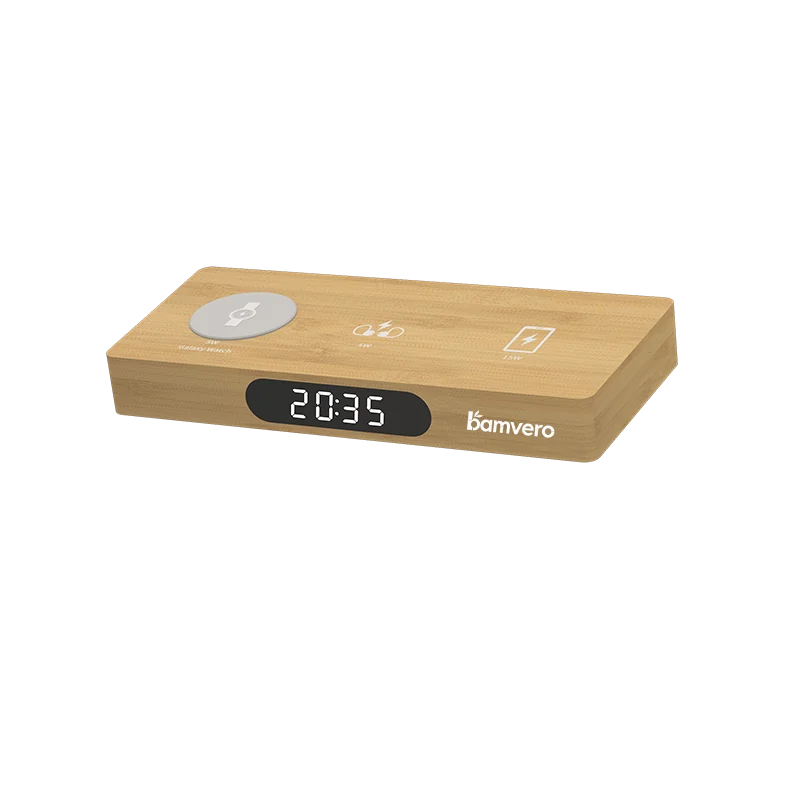
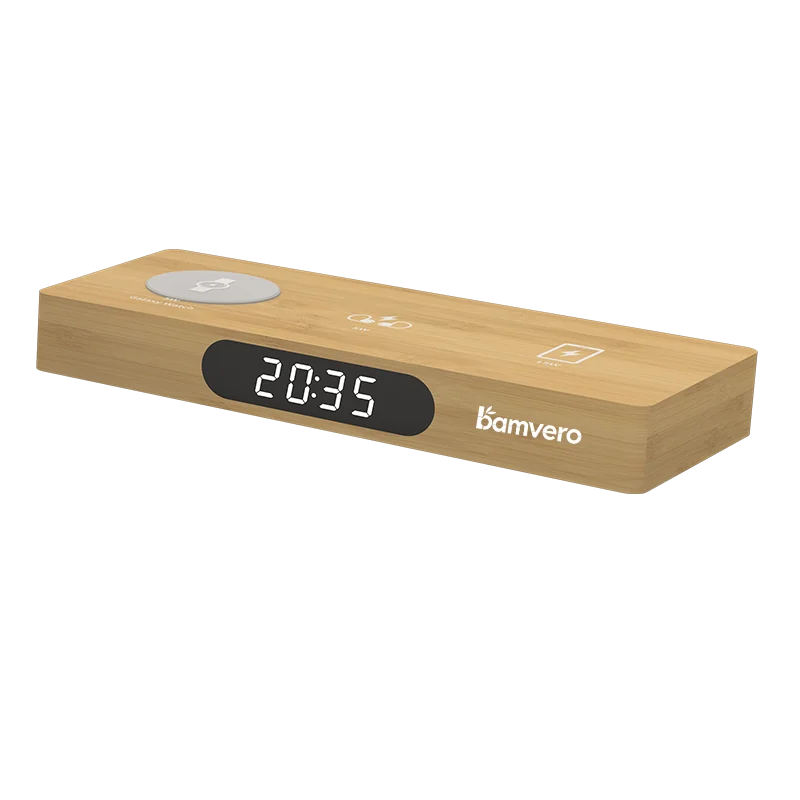
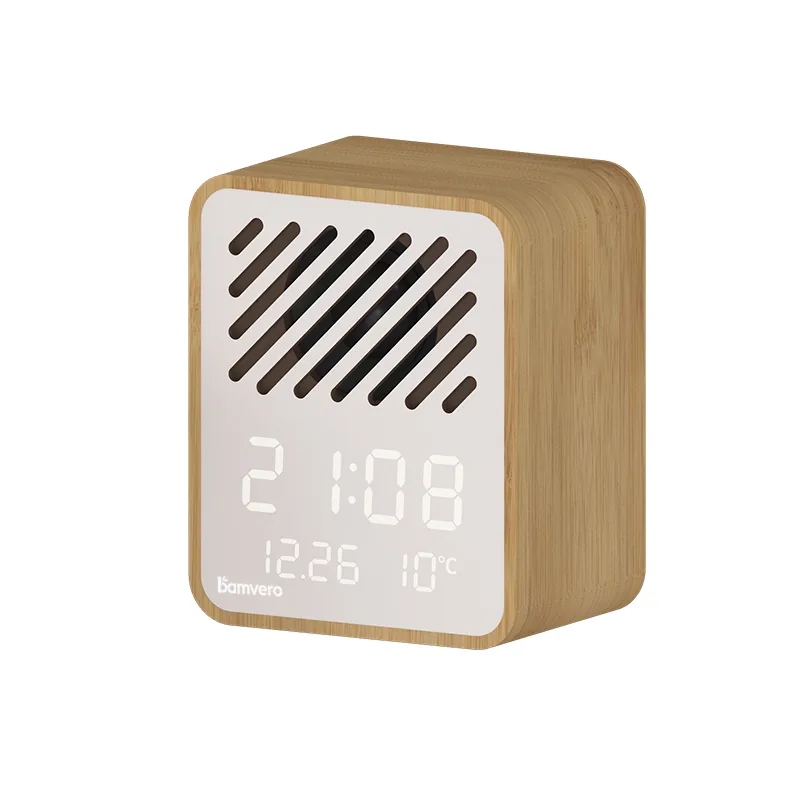
Before planning a mixed-model order, compare 2106 bamboo LCD temperature clock, W120 3-in-1 charging clock, Y130-1 Bluetooth speaker clock and confirm the requirements for your project.
Who This Guide Is For
This guide is for wholesalers, distributors, online sellers, corporate-gift channels and lifestyle retailers that want to source several bamboo electronics models in one program without creating an assortment of near-identical products.
A mixed-model order works when every item has a defined job. One model may provide a compact clock option, another adds wireless charging, another organizes a desk, and another introduces audio. The purpose is not to maximize the number of SKUs. It is to give the buyer a controlled way to test different customer needs while keeping specifications, packaging and reorder decisions understandable.
The model facts below are taken from the current Woodshowtime product pages. MOQ, mixed-carton rules, price, lead time, accessories, certification scope and warranty must be confirmed in the current quotation.
Quick Decision Guide
| Product role | Example model | Confirmed facts | Reason to include it |
|---|---|---|---|
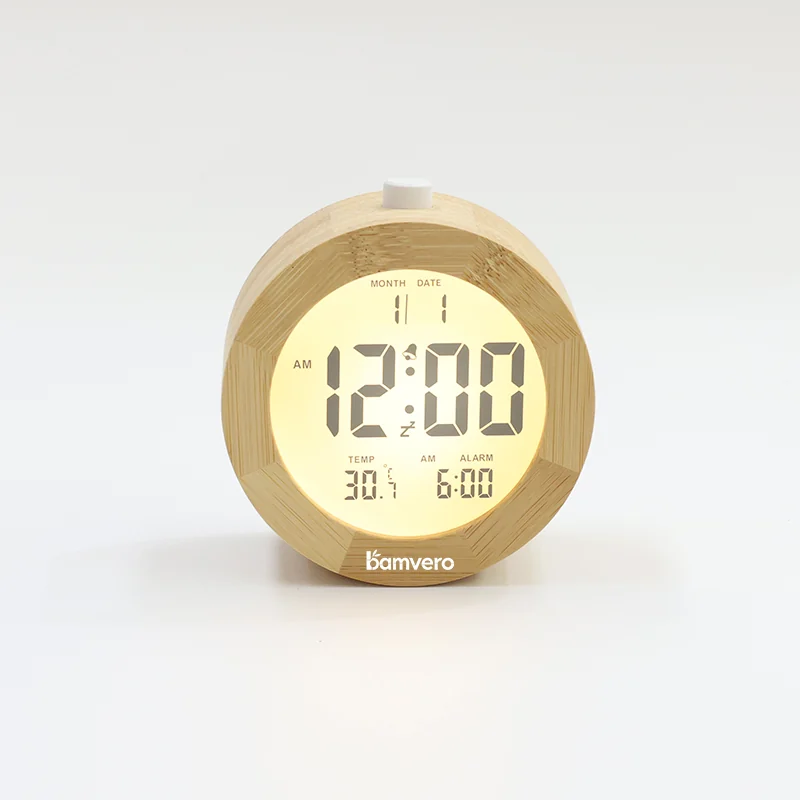
| Compact clock | 2106 | Natural bamboo with LCD time, month, date, temperature and alarm display; multiple body shapes; 96 x 45 x 96 mm for listed standard shapes | Gives the range a small, non-charging clock option |
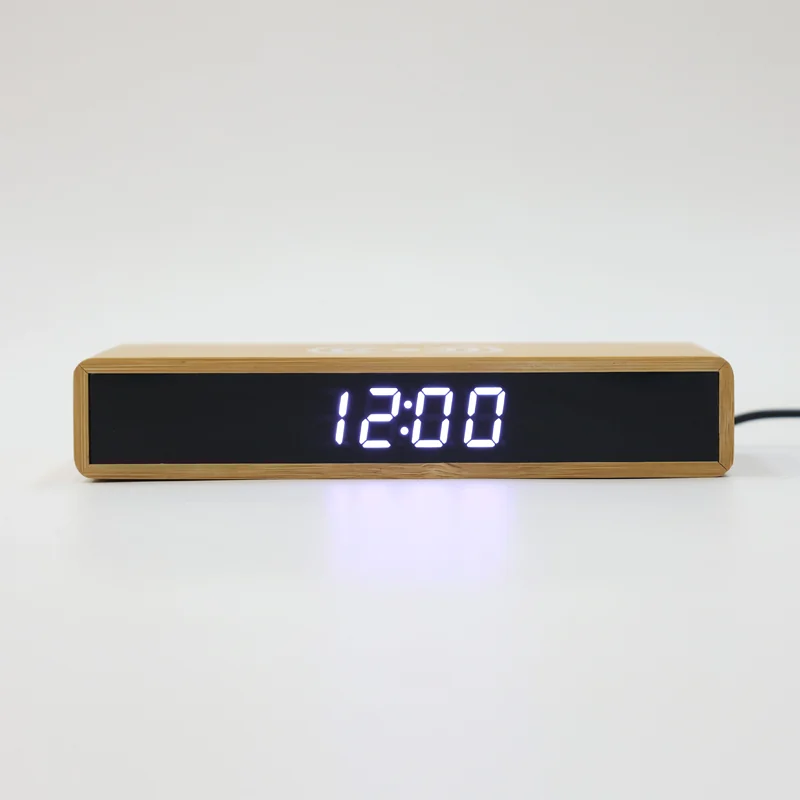
| Compact charging clock | W101 | Natural bamboo, 15W wireless charging, 160 x 75 x 29 mm | Adds a low-profile charging format for bedside or desktop placement |
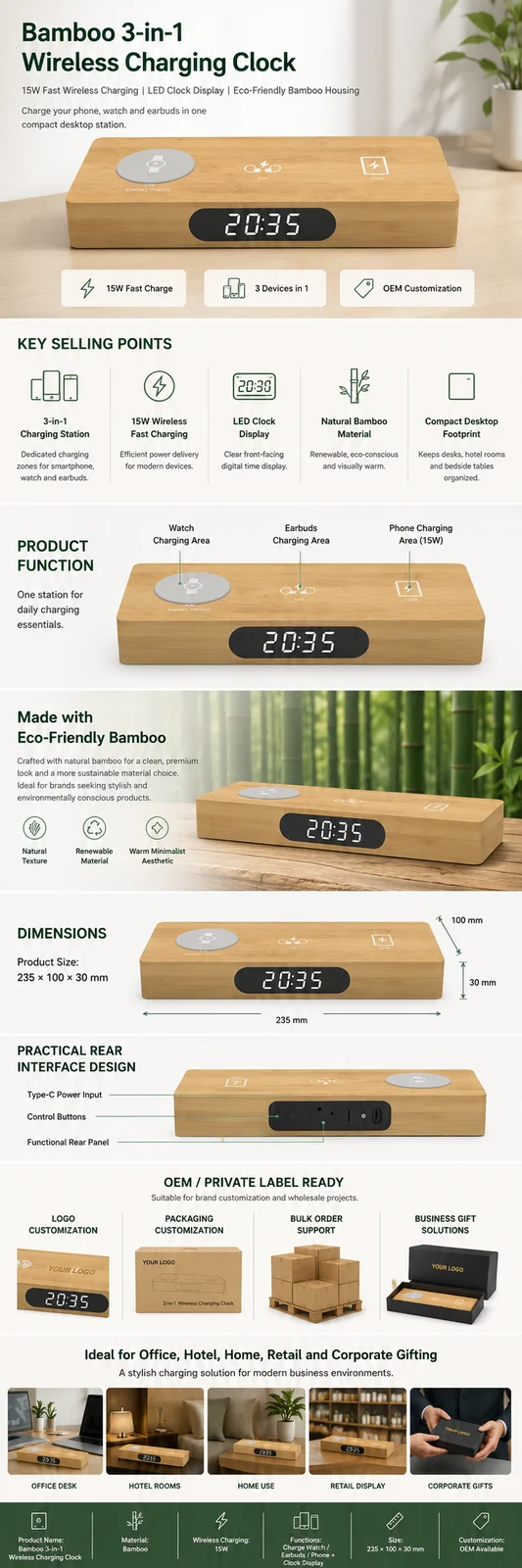
| Multi-device charging | W120 | Natural bamboo, multi-device wireless charging, 235 x 100 x 30 mm | Creates a separate role for buyers comparing more than one charging position |
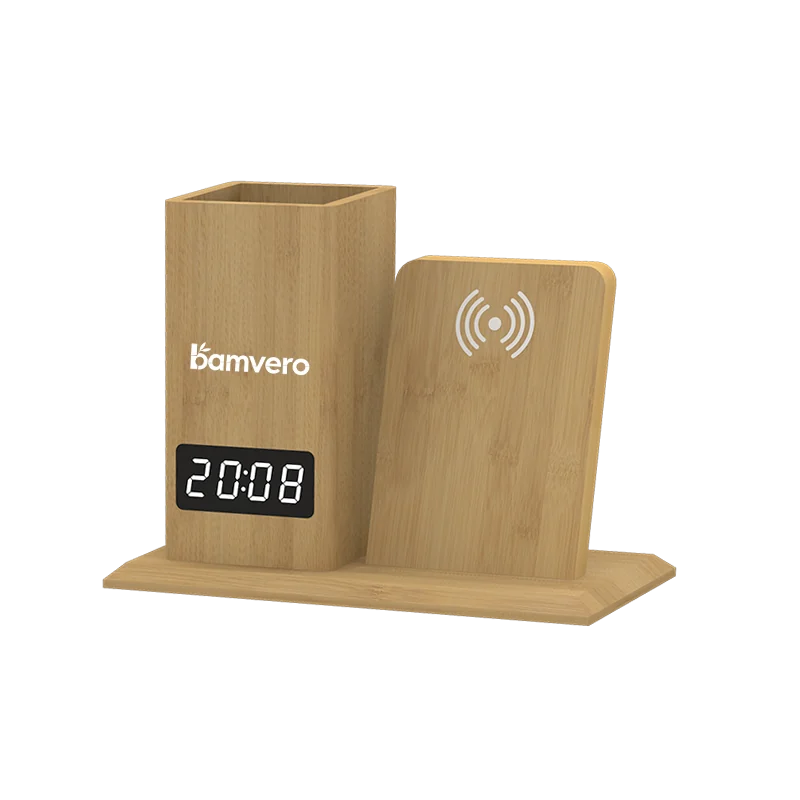
| Charging and storage | W125 | Natural bamboo, 15W wireless charging, 188 x 95 x 143 mm | Adds vertical pen storage and a clear office-desk use case |
| Audio clock | Y130-1 | Bamboo-style housing, Bluetooth speaker alarm clock, LED time/date/temperature display, 115 x 65 x 95 mm | Adds an audio-led option without duplicating the charging-clock role |
The “confirmed facts” column is not a complete specification. For each model, request the exact function list, power input, accessories, packaging, market documents and sample test requirements.
Start With Customer Jobs, Not SKU Count
Before requesting a mixed-model quote, write down the customer jobs your range needs to cover. A practical range might include:
- a simple desk or bedside clock;
- a compact wireless charging clock;
- a multi-device charging station;
- an organizer for office desks;
- an audio or speaker-clock option.
If two proposed products serve the same job, compare their dimensions, display, finish, packaging footprint and price position. Keep both only if the difference will be clear in a product listing or retail display.
This prevents a common problem: several models look different in a supplier catalog but appear interchangeable to the customer. Interchangeable models divide stock, photography and advertising without adding a new reason to buy.
Give Every Model a Role in the Assortment
Use a role map before discussing quantities:
Core model
The core model should explain the range quickly. It needs a clear function, readable presentation and a specification that the sales team can describe consistently. It does not have to be the cheapest model.
Step-up model
The step-up model adds a visible function or stronger use case. W120, for example, can represent the multi-device direction, while W125 can represent charging plus desk storage. The step-up story must be visible and testable, not just a longer feature list.
Alternative-use model
An audio clock such as Y130-1 can reach a different customer need from a charging clock. A compact LCD clock such as 2106 can give buyers a non-charging option with a different display style and body shape.
Test model
A test model is included because its design or function may suit a specific channel, not because it is assumed to sell well. Set a measurement period and decide in advance what would justify a reorder.
Standardize the Quotation Before Comparing Prices
Mixed-model quotations become misleading when each line uses a different packaging, power supply or customization scope. Send one comparison sheet with the same requested fields for every model.
| Quotation field | Why it matters |
|---|---|
| Exact model and configuration | Prevents a sample or quote from referring to a different electronics version |
| Quantity per model and total quantity | Shows whether pricing or MOQ is calculated by SKU or by combined order |
| Unit packaging | Allows comparison of retail readiness and protection |
| Included cable and adapter | Prevents different accessory scopes from appearing as price differences |
| Logo and artwork method | Separates standard product cost from branding setup or process cost |
| Carton dimensions, quantity and weight | Supports freight and storage planning |
| Sample cost and sample revision route | Clarifies what can be checked before the order |
| Lead time and quote validity | Keeps scheduling and price assumptions current |
| Warranty and claim process | Allows the reseller to plan after-sales handling |
| Destination-market documents | Keeps document scope tied to each exact model |
Do not fill unknown fields with assumptions from another model. Mark them as pending supplier confirmation.
Verify Specifications by Product Family
A mixed order can include clocks, wireless charging products and Bluetooth audio. Each family needs a different sample test.
For display clocks, check viewing angle, control sequence, alarm behavior, power-loss behavior and the functions shown on the exact display.
For wireless charging products, confirm the output profiles, input supply, cable and adapter, device and case test list, alignment, indicator behavior and instructions. A 15W model should still be tested with the representative devices used by the target channel.
For Bluetooth speaker clocks, confirm the Bluetooth module information provided for the model, pairing name, reconnection, audio controls, clock controls, display information and power input. Do not copy a Bluetooth version or range from another speaker.
For every bamboo housing, review visible grain variation, joints, finish, base stability, logo result and packaging protection. Natural variation and assembly defects should have separate acceptance criteria.
Plan Packaging as a Range
Packaging can make a mixed assortment feel coordinated even when product shapes differ. Ask whether the range can use a consistent hierarchy for brand logo, product name, key function, model number and instructions.
At the same time, do not force one insert or carton structure onto every product. W125 has a taller profile than W101, while W120 has a wider multi-device footprint. Each package needs protection and accessory space suited to the actual unit.
Review these range-level questions:
- Can the front panels use a consistent brand system without hiding model differences?
- Are model numbers and function names easy to distinguish in storage and picking?
- Do manuals state the correct controls and power requirement for each model?
- Can barcodes, carton marks and destination labels be managed by SKU?
- Are product images based on the final approved configuration?
- Can replacement units and accessories be identified without opening every box?
Use a Controlled Sales Test
The first mixed-model order should answer specific questions. Define the measurement plan before the products arrive.
Track each model separately:
- units received and units available for sale;
- product-page views or retail interactions;
- conversion or sell-through in the same measurement window;
- customer questions before purchase;
- return and complaint reasons;
- packaging damage;
- charging, control or compatibility issues;
- gross margin after discounts, fees and returns;
- stock remaining when the review period ends.
Do not compare models launched on different dates or promoted with different budgets as if the result came only from the product. Record the channel, price, placement and promotion used for each test.
Turn Test Results Into a Reorder Decision
At the end of the test, assign each model one action:
- Reorder: the role is clear and the model meets the channel's performance and service thresholds.
- Revise: demand exists, but listing copy, packaging, instructions or configuration needs correction.
- Hold: more data is needed or the season makes the current result unreliable.
- Replace: another model can perform the same role with a clearer offer.
- Remove: the model adds complexity without a distinct customer job.
Keep the URL and sales history when only the packaging or content is improved. Do not treat every small revision as a new product launch.
Common Mixed-Model Buying Mistakes
Ordering several models with the same role
This creates internal competition and thinner stock per SKU. Keep a model only when its use case or position is easy to explain.
Comparing incomplete quotations
A lower price may exclude an adapter, branding, packaging or document work included elsewhere. Standardize the quote fields first.
Assuming one document covers the full range
Regulatory and test documents are model- and configuration-specific. Verify scope separately.
Using the same sample checklist for every product
A Bluetooth speaker clock, an LCD clock and a wireless charging station require different functional checks.
Reordering from impressions alone
High page views without conversion, or sales with frequent returns, can hide a weak product role. Review commercial and service data together.
Final Buyer Checklist
- Define the customer job for every proposed model.
- Remove duplicate roles before requesting prices.
- Record confirmed facts and open questions separately.
- Request the same quotation fields for every SKU.
- Confirm whether MOQ and pricing apply per model or across the combined order.
- Test display, charging and Bluetooth products with family-specific checklists.
- Approve logo, packaging and manuals by exact model.
- Collect carton data before planning freight and storage.
- Set the sales-test window and metrics before launch.
- Assign a reorder, revise, hold, replace or remove decision after review.
For a useful mixed-model proposal, share your target channel, destination market, preferred product roles, estimated total quantity, quantity by model, branding needs and target launch window. Woodshowtime can then prepare a focused assortment instead of sending an unfiltered catalog.
Related sourcing resources
Methodology and official references
Product roles use current Woodshowtime model pages. Confirm model-level specifications, documentation, MOQ, packaging and commercial terms in the current quotation.
Frequently asked questions
How many models should a first mixed wholesale order include?
There is no universal number. Start with the fewest models that cover distinct customer jobs and fit the supplier MOQ, test budget, shelf space and measurement plan.
How can buyers compare quotations from different bamboo electronics models?
Normalize the model code, functions, power supply, accessories, packaging, customization, testing, trade term and quantity before comparing unit prices.
Can one sample checklist cover clocks, chargers and speaker clocks?
Use a shared cosmetic and packaging section, then add category-specific checks for clock controls, charging behavior, Bluetooth, audio and any battery configuration.
Should all models use identical packaging?
They can share a brand system, but inserts, accessories, instructions, warning labels and carton protection must match each exact product.
Which data should determine a reorder?
Review sell-through, contribution margin, returns, defect and complaint reasons, customer questions, stock cover and supplier lead time by model-not just page views.
Build the specification before comparing the final price.
Align the target channel, product functions, destination market, branding and packaging route before approving a sample or bulk quotation.